Long-distance travelers as well as commuters are connecting on sites like Zimride.com, Ridejoy.com, Avego.com, Nuride.com, Rideshare.com and eRideShare.com. This summer, a German company with a quintessential American name, Carpooling.com, will try to break into the United States market with a trial run in the Northeast. In June, the company announced that 30 million rides had been offered through its 10-year-old network, which now has 3.8 million registered users. Ride-sharing and car-pooling, it seems, are having a moment in the United States after many fits and starts. “It’s been a tough sell in the U.S. for a long time,” said David Burwell, director of the energy and climate program at the Carnegie Endowment for International Peace. “A lot is due to not only the fact that people have different places they want to go, but also safety and other concerns about going into a car with strangers.” What is different now, Mr. Burwell said, is the advancement of digital technology and social networking, “which removed a significant amount of barriers.” To that end, eRideShare, which was started in 1999, is testing a mobile app this week for iPhone and Android phones. “I see a lot of new entrants this year” as well as new technology, said its founder, Steven Schoeffler. “I think it will be a very interesting time for ride-sharing.” The sites vary in the process of matching drivers with passengers, security protocols and how payment is calculated and made. Some sites allow participants to settle on the cost of a ride; others charge by mile traveled. The profit-making sites take a percentage of the fee charged to riders, but it’s free to sign up for the service. Proponents of ride-sharing say that, by design, it is an effective way to reduce congestion and greenhouse gas emission, as well as to save money on gasoline and car maintenance. America’s love affair with cars is not fading into the sunset anytime soon. By Sunday, 42.3 million Americans will have journeyed 50 miles or more from home during the weekend after the Fourth of July, according to AAA estimates. That is up 5 percent from last summer. On any workday, however, most drivers are riding solo. The percentage of people car-pooling has hovered near 10 percent for several years, according to Census survey data. About 5 percent of commuters use public transportation, and 76 percent drive alone. “The reality is, we do it because it happens to be the most convenient best option for us,” said Paul Steinberg, director of Americas at Avego, a multinational transportation company that is conducting several real-time ride-sharing tests in the United States. “We are trying to convince 85 percent of the population to give up their car — not every day, but a couple of days a month — and pick up someone or share a ride,” Mr. Steinberg said. “It’s a big challenge; it’s harder in the U.S. than other geographies.” American culture is partly the reason, he said, as is sprawl and subsidized gasoline. In Sonoma County, Calif., Avego is helping to run a private-public nonprofit program called WeGoRideShare.com. Two testers, Monika Loose and Cyndi Mills, employees of the Sonoma County government, found each other through a ride board on the Web site and have recently shared rides a few times a week. Ms. Loose is a passenger and helps pay for gas. She drives from her home to a nearby Park and Ride lot, where Ms. Mills picks her up. Together, they can ride in the high-occupancy vehicle lane, which reduces their commute time. “For me,” Ms. Loose said, “I’m not an everyday car pooler, maybe three days a week. I like to have my car other days to do other errands.” That also works for Ms. Mills, who says the few days add up and help defray her monthly gas costs. Because she is often transporting her children, she said, “I don’t want people dependent on me every day.” Tara Weingarten, founder of the automotive site vroomgirls.com, said ride-sharing could work regionally for some commuters but faced resistance in car-centric places like Southern California, “where drivers are used to being cocooned in their private auto bubbles padded with comfy seats, satellite radio, climate control and privacy, where they don’t have to make chitchat if they’re not in the mood.” Even so, companies that promote the exchange of rides are joining a wave of so-called collaborative consumption sites that use social networks to build communities like Airbnb.com, for finding a place to stay, Swap.com, for exchanging goods, and TaskRabbit.com, for outsourcing tasks and errands.
Tuesday, July 10, 2012

Monday, July 9, 2012
Digital Domain: Movie Screens, Small to Big to Small Again - Digital Domain
The earliest motion-picture viewing was a solitary experience. One looked through a peephole at the top of a Kinetoscope, a waist-high cabinet in which a light illuminated the frames of a continuous film loop. A magnifying lens was attached to the peephole, but the images remained tiny. That means the first cinematographers didn’t have much to work with. When projection arrived, movie images could be made life-size in a theater, then larger than life, on a big screen accompanied by big sound. Taking in a movie became not just an immersive experience, but also a social one, with members of the audience sitting in the dark together, laughing, crying and shrieking. Today, we’ve reached the acme of technical sophistication — and have come nearly full circle. Movie watching is, again, a solitary experience, involving small images on a laptop, a tablet and, tinier still, a cellphone. The convenience is wonderful, of course, but it comes at a price: the loss of the immersive cinematic experience. Americans will pay to watch 3.4 billion movies online this year, IHS Screen Digest estimates. That’s much more than double the number for 2010. It’s impossible to say exactly how many of those movies will be viewed on which portable devices. A spokesman for Netflix, the leader in streaming older movie titles, declined to share details about streaming device destinations. We do know that the newest movie titles, including the most visually spectacular, are available through Apple or Google for inexpensive rental on the small screen. (Apple made movie rentals available for phones starting in 2008, and Netflix introduced a smartphone app in 2010). Cellphone owners can rent “Hugo,” the 2012 Academy Award winner for cinematography, for $3.99 and watch it on a screen whose size is not much larger than the image seen through the Kinetoscope’s peephole. When an online movie is viewed at home on a giant flat screen and heard through an expensive sound system, the sensory experience surely exceeds what might be had at a rundown multiplex on a bad day. But movies viewed on mobile devices aren’t going to give the brain’s sensorium much stimulation. “It’s a sensual experience when you go to a theater, if there’s sharp projection and six-track sound,” says John Belton, a professor of English and film at Rutgers University. “That is a very different experience than watching on an iPad” or on other portable devices. Professor Belton points out that the first projected images in theaters were not all that large. In a movie palace that might hold 5,000 people, an early screen might have been only 15 feet wide. But the images became larger around the time that sound arrived in the 1930s. Then, in the 1950s, as Hollywood found itself competing against television, it used special lenses to create movies for screens of expanded width. Marilyn Monroe’s body, in languorous repose, would stretch across screens as wide as 64 feet. This was an intentional shift, Professor Belton says, to “an image that overwhelms the spectator,” part of Hollywood’s campaign “to show the limitations of television.” Later, Hollywood reversed course and began selling to television, though that meant cropping its wide-screen pictures so they would fit on a small screen. The most glorious attempt to fully engage the theater spectator’s senses was Cinerama, introduced in 1952. Filmed with three cameras outfitted with wide-angle lenses, it used three wide screens, put together in a sumptuous near-semicircle of 146 degrees. “This gives you a ‘first-person’ experience,” says Thomas Hauerslev, editor of the Web site In70mm. “You see what you’d see if you were sitting where the camera is.” He says IMAX “is not a first-person experience — it’s just big.” Each frame in Cinerama is 50 percent taller than a regular frame, providing more detail. This makes the cinematic illusion “extremely realistic,” Mr. Hauerslev says. Cinerama was costly both to film and to exhibit, and its commercial life was short. It was used only for travelogues, except in 1962, when the only two story-centered features were released: “How the West Was Won” and “The Wonderful World of the Brothers Grimm.” The Cinerama name was transferred to a smaller format, and then that format, too, was abandoned. Cinerama was the high-water mark in sensory immersion. Yesterday’s Kinetoscopes and today’s smartphone screens, the low-water marks. “If you look at the great Hollywood classics in the 1930s and 1940s, you’ll see many wide master shots and sparing use of close-ups,” says John Bailey, a cinematographer with more than 60 feature credits who serves on the executive board of the American Society of Cinematographers. “But with the advent of TV and now also with smaller screens, we’re seeing more close-ups.” The problem, he says, is that “if you use close-ups immoderately, then when you need to make a more dramatic point, you have no other option but to use extreme close-ups.” “The best camera,” the old saying goes, “is the one you have with you,” and a similar thought is apparently held by increasing numbers of movie viewers, happy with the screen they always have with them. And movie producers, just as they have in the past, will probably keep adapting, changing movies themselves so that they look better on a tiny screen. “You can say it’s ‘watching a movie,’ ” says Professor Belton of viewing on mobile devices. “But it’s not cinema.”
Randall Stross is an author based in Silicon Valley and a professor of business at San Jose State University. E-mail: stross@nytimes.com.
Sunday, July 8, 2012
European Parliament Rejects Anti-Piracy Treaty
PARIS — European legislators on Wednesday rejected an international treaty to crack down on digital piracy, a vote that Internet freedom groups hailed as a victory for democracy but that media companies lamented as a setback for the creative industries. Foes of the treaty said the vote, by an overwhelming margin in the European Parliament at Strasbourg, would probably end the prospects of European involvement in the Anti-Counterfeiting Trade Agreement, or ACTA, which has been signed by the United States, Japan, Canada, Australia, South Korea and a number of individual E.U. members. For campaigners against restrictions on the Internet, it was the latest in a series of political victories, after the U.S. Congress last winter abandoned proposed U.S. laws aimed at curbing the unauthorized sharing of music, movies and other digital media. Treaty opponents had rallied tens of thousands of protesters to the streets of European capitals last winter, dangling the threat that approval of the pact would lead to the proliferation of anti-piracy measures. Opponents of the treaty said that even if other countries decided to proceed with ratification of the pact, it might have little authority, given that the E.U. represented 27 of the 39 countries that participated in the talks in the first place. After the vote, some members of the Parliament stood up in the chamber, displaying placards reading “Hello democracy, goodbye ACTA.” Groups representing movie studios, publishers, record labels and other rights holders bemoaned the outcome, saying protesters had twisted the debate to make the treaty seem more menacing than it actually is. The vote, they added, would hurt efforts to reduce online copyright theft, potentially costing Europe jobs at a time when it desperately needs them. The Parliament “has given in to pressure from anti-copyright groups despite calls from thousands of companies and workers in manufacturing and creative sectors who have called for ACTA to be signed in order that their rights as creators be protected,” said Angela Mills Wade, executive director of the European Publishers Council. Publishers and other copyright owners, like the Motion Picture Association, the International Federation of the Phonographic Industry and the Business Software Alliance, were hoping that ACTA would provide them with a powerful tool to pursue rights violations, especially in developing countries, where enforcement can be lax. But opposition to ACTA spread online after word emerged several years ago that governments were negotiating the pact behind closed doors. Scare stories spread, with bloggers talking of alarming proposals to let border guards search airline passengers’ iPods for pirated music. The final agreement, signed by the U.S. government last autumn, includes no such measures. Still, opponents say it could provide a legitimate international framework for anti-piracy tactics they abhor, like the three-strikes system in France, under which repeat offenders face the suspension of their Internet access. The pact also calls for Internet service providers to take steps to enforce copyright, something they have generally resisted on the grounds that they are mere conduits for digital traffic. “That would require a major and unhealthy shift in how the Internet works,” said Monique Goyens, director general of BEUC, the European Consumers’ Organization, in Brussels. “It would establish a de facto and evidently unwilling Internet police.” The vote was not even close, with 478 members of Parliament opposing the treaty, only 39 supporting it and 146 abstaining, yet it leaves considerable uncertainty. Under E.U. law, the treaty cannot go into effect without the Parliament’s endorsement. “It’s a crushing victory,” said Jérémie Zimmermann, spokesman for La Quadrature du Net, a group in Paris that was active in the treaty protests. “It’s a political symbol on an enormous scale, in which citizens of the world, connected by the Internet, have managed to defeat these powerful, entrenched industries.” The European Commission, which represented the 27 member states of the European Union in the negotiations, had already suspended efforts to ratify the pact, amid the outpouring of public anger. Instead, it referred the agreement to the European Court of Justice to determine whether it was lawful. Karel De Gucht, the European trade commissioner, said the commission would wait for the court’s ruling, which could take several months, before consulting with trade partners on how to proceed. “It’s clear that the question of protecting intellectual property does need to be addressed on a global scale,” he said in a statement. “With the rejection of ACTA, the need to protect the backbone of Europe’s economy across the globe — our innovation, our creativity, our ideas, our intellectual property — does not disappear.” Carol J. Guthrie, a spokeswoman for the U.S. trade representative, said the other ACTA signatories could still put the agreement into effect, even without E.U. involvement. “In that case, ACTA’s membership may initially be more Pacific-oriented than would be true with E.U. participation,” she said. “It is unfortunate that there has been so much misrepresentation of ACTA, because its language explicitly preserves free expression and privacy while fighting commercial-scale intellectual property theft. There continues to be a need for international cooperation on these issues, and the ACTA can still serve as a valuable forum through which countries can coordinate to stop counterfeit trade and piracy.”
Bits Blog: Olympus and Apple Join Google With Wearable Computing
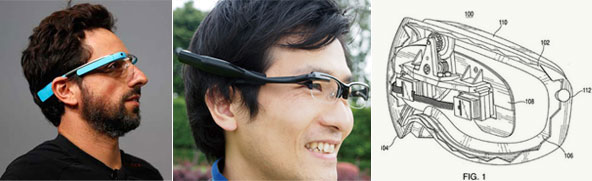
It seems that everyone in tech has been busy working on wearable computing and augmented reality glasses.
Last week, Sergey Brin, Google’s co-founder, showed off augmented reality Google Glasses at the company’s Google I/O annual developer conference.
Now Olympus is pulling the curtains back on its own wearable computer glasses. In a news release, Olympus announced the “MEG 4.0 ultracompact wearable display prototype,” which it said “can be used in everyday life.” The company said that the MEG 4.0 “display does not obstruct the view of the outside world” and that the glasses only weighed 30 grams, including the battery.
The Meg 4.0 requires a Bluetooth connection to a smartphone, which is then used to share information back to the Olympus display. Pricing and a release date were not discussed in the release.
Meanwhile, Apple also seems to be working on wearable computers.
The company has filed repeated patents for displays that are embedded in goggles and glasses. This week Apple was also awarded a patent for a “Peripheral treatment for head-mounted displays” that can be used to project an image into someone’s eye.
While some companies focus on glasses as wearable computers, there is always the possibility of computerized contact lenses.
Babak Parviz, who is working at Google on the company’s glasses project, specializes in bionanotechnology, which is the fusion of tiny technologies and biology. Mr. Parviz was part of a team that built a tiny contact lens embedded with electronics.
A report issued by Forrester Research earlier this year noted that wearable computing will bring a “new platform war,” not dissimilar to the mobile app battles today, between Apple, Google, Microsoft, Amazon and Facebook, along with each company’s developer communities.
“Imagine video games that happen in real space,” the report said. “Or glasses that remind you of your colleague’s name that you really should know. Or paying for a coffee at Starbucks with your watch instead of your phone.”
As I noted in my column in The New York Times this week, these wearable computers are the future and will finally “allow technology to get out of the way.”
View the original article here
Saturday, July 7, 2012
U. of Washington, a Northwest Pipeline to Silicon Valley
SOME budding entrepreneurs and computer whizzes based here in the Pacific Northwest are starting to turn heads down in Silicon Valley. They are professors and students at the University of Washington, home to what may be the best computer science department you’ve never heard of. Although Stanford is considered the Hogwarts of techdom, U.W. has quietly established itself as the other West Coast nexus of the information economy. And while Seattle-area tech icons like Microsoft and Amazon have long relied on U.W. — pronounced “U-dub” by locals — as an incubator of talent and ideas, the Valley’s hottest companies have been getting the message, too. Their executives have begun streaming up the coast to Seattle, fueled by a talent arms race for programmers. Facebook, Zynga and Google have opened offices in the area, trying to woo U.W. engineers who’d rather live here, where taxes and home prices are lower, even if mist and dark skies envelop the scenery for much of the year. “It’s the most underrated computer science department I’ve seen,” said Ari Steinberg, a Facebook engineer who runs the company’s Seattle office, which opened in early 2010. The university’s computer science and engineering department, ensconced on a patch of land near Husky Stadium and Lake Washington, has come a long way since the early 1970s. During that time, two Seattle teenagers, Bill Gates and Paul G. Allen, honed programming skills by sneaking into the department to tinker on its computers. The department’s stature began to pick up in the 90s, as the university began to significantly expand its computer science faculty with new stars like Oren Etzioni. At the same time, Microsoft, the company that Mr. Gates and Mr. Allen founded, jump-started the Seattle technology scene and many fortunes along with it. Mr. Gates, Mr. Allen and others became big contributors, helping the university build a new home for its computer science program. In recent years, the department has deepened its ties with tech companies like Google, helping to gain an edge in teaching programming for the cloud, a big trend in computing. In the most recent rankings by U.S. News & World Report, the graduate program placed seventh in the nation, right behind Cornell and the University of Illinois at Urbana-Champaign. (Tied for first were Stanford, Carnegie Mellon, the Massachusetts Institute of Technology and the University of California, Berkeley.) The U.W. department’s growing recognition has been a blessing for its students, who are getting juicier job offers with top companies. But some Seattle technology executives say the competition is crimping the city’s homegrown technology scene, making it into something like a colony of Silicon Valley. According to the university, some 35 percent of its computer science graduates end up working at Amazon, Google or Microsoft in a typical year; 15 percent go to other big companies and 30 percent to small companies or start-ups. More than 80 percent of the program’s students come from Washington State, and the same percentage end up staying in the state after graduating, even if they work for companies based in Silicon Valley. The biggest problem with the university’s program is that it can’t turn out graduates fast enough. Engineers are in short supply in the computer field generally, but this is a particular concern in the Seattle tech market. “We need that program to be a lot bigger,” says Spencer Rascoff, chief executive of Zillow, a real estate Web site based in Seattle. IN a conference room at the university, overlooking the sparkling waters of Lake Washington, Christophe Bisciglia told a crowd of dozens of students what his secret weapon was: them. Mr. Bisciglia, 31, an entrepreneur and former star Google engineer, was visiting during the spring to speak on a panel about start-ups to computer science students. He said he has gained an “unfair advantage” for WibiData, his new San Francisco-based company, by recruiting from the university’s computer science department, where two-thirds of his employees once studied. “Down in the Valley, it’s all Stanford this and that,” said Mr. Bisciglia, himself a U.W. graduate. “While they turn out students that are good, U.W. turns out students that are every bit as good.” The deep connections between U.W.’s computer science program and the Seattle tech scene are written on the wall, literally. The department is housed in the Paul G. Allen Center for Computer Science and Engineering, a brick-and-glass building with a soaring, six-story atrium in the center of campus. The building, which opened in 2003, provided a big boost to the program, adding lab space for robotics experiments and replacing a structure that “was falling down around us,” said Ed Lazowska, who joined the computer science department in 1977, and was chairman for eight years. Mr. Allen was the leading donor for the construction of the building, along with Mr. Gates. Mr. Lazowska holds the Bill & Melinda Gates Chair in Computer Science and Engineering. Many other notables from Seattle tech companies have also contributed money. Like their peers at Stanford, U.W.’s computer science faculty members say that one of their program’s strengths is the engagement between professors and the tech industry that will one day employ most of the graduates. Henry M. Levy, the current department chairman, is a co-founder of two tech start-ups. Mr. Etzioni is a co-founder of several Internet companies that were later acquired, including Farecast, an airfare price prediction service that Microsoft bought for $115 million in 2008. Along with four Washington graduates, Mr. Etzioni recently formed another company, Decide.com, which helps consumers time their purchases of iPads and other electronics to avoid missing price drops. He is a venture partner at Madrona, a Seattle venture capital firm that invested in Decide.
Subscribe to:
Posts (Atom)